
By Sheila O’Malley
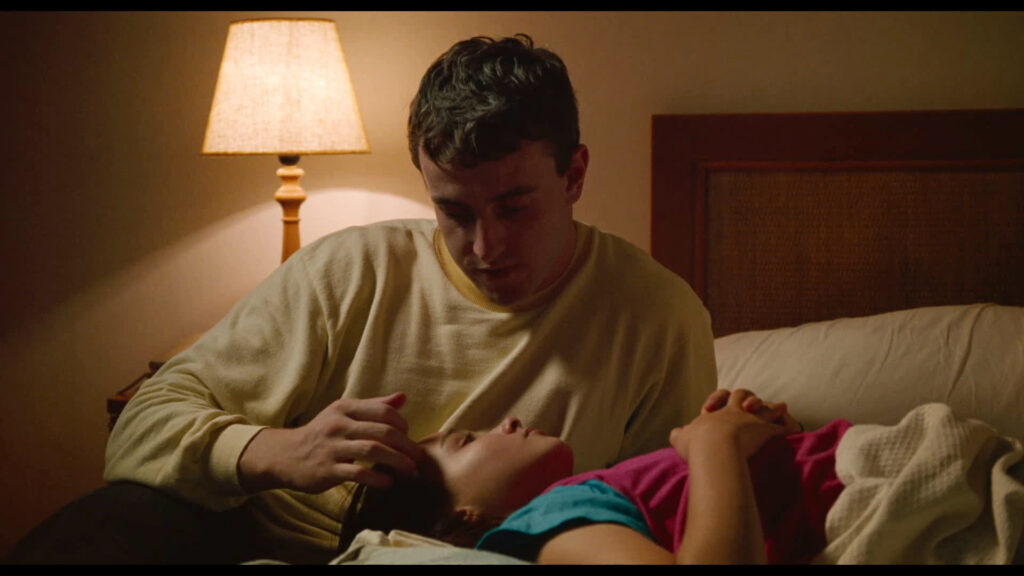
In the foreground, an 11-year-old girl lies asleep in bed. On the balcony beyond, seen through the plate-glass door, the girl’s father struggles to light a cigarette, hampered by the cast on his right arm. Mission accomplished, he sways back and forth rhythmically, arms moving outwards and upwards and down, a dreamy approximation of Tai Chi moves, perhaps. It’s not quite clear what is going on with him, since the camera doesn’t move in closer, and there are barriers separating us from him. This is a moment of solitude for the father, snatched at the end of the day when his child is asleep. The daughter’s deep breathing provides the rhythm for the father’s movements, and there’s something almost eerie about the moment. The 11-year-old daughter sleeps through it all.
But what is “it,” exactly?
This question lies at the shifting center of Charlotte Wells’ moving debut feature “Aftersun,” detailing a father-daughter vacation at a cheap resort in Turkey, and the scene above—which comes early on, when we’re still getting our bearings—is key. There’s something unknowable about Calum (Paul Mescal), and maybe this is because Sophie (Frankie Corio) is a child, and he’s her dad, and she’s just about coming to the age where she’s separating herself and becoming her own person.
There’s an uneasiness in the sequence, but the source of it is hard to place, or even name, particularly since Calum and Sophie are enjoying their vacation, overall. The occasional friction is of the normal parent-child variety, nothing too toxic, nothing too traumatic. But the depths, as they say, are sounded. The child is perceptive, and senses things, even if she can’t put it into words (although often she can). She perceives more than her father thinks she does. But children are resilient. It is possible to perceive a parent’s existential anxiety and still have a great time making a new friend at the arcade. The two things even happen simultaneously. Consciousness operates on multiple tracks and “Aftersun” understands this. The multi-level awareness is not in the dialogue, but it’s there in the film’s gentle rhythms, the editorial choices, the patience and sensitivity of Wells’ approach.
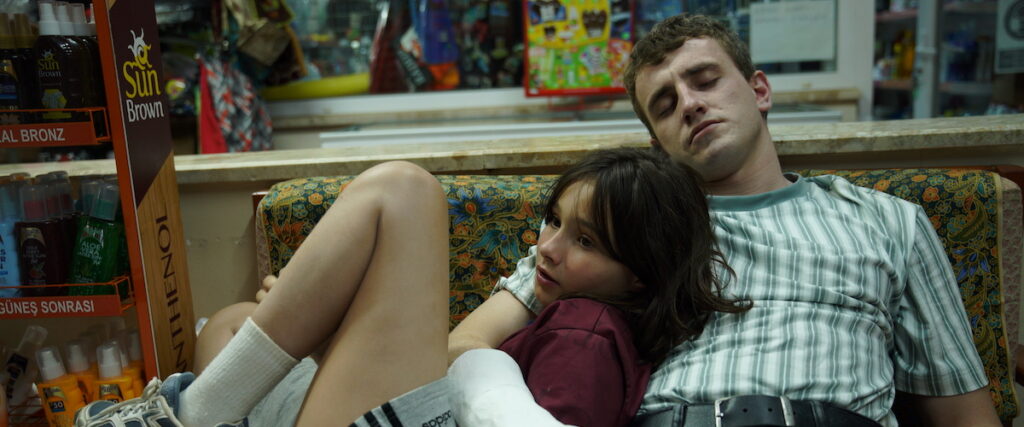
Sophie’s parents are separated, and she lives mainly with her mother. Calum talks about getting a new place, where Sophie will have her own room, and maybe starting a new business with someone named “Keith,” and from the way he talks about all this it’s obvious he barely believes in any of it. Something’s not gone right for him. Does he party too much? He became a father at a young age. There are “clues” that his life hasn’t quite worked out the way he had hoped. He has brought books on meditation and Tai Chi, suggesting not so much a lifelong practice as a way to stave off anxiety. His worries weigh him down. Sophie senses this. It’s tense when she loses her scuba mask, and she informs him she knows it’s expensive and she’s sorry. Calum is taken aback by her remark. He thought his worries were well-hidden. Calum may be a bit adrift, but he clearly loves his daughter. They have a little tiff at one point, and he apologizes to her later for his behavior. He’s a good dad. Their energy together is comfortable, intimate, familiar.
Wells’ 2015 short film “Tuesday” could be seen as “Aftersun” in embryo. A college student spends Tuesday nights at her dad’s, even though her mother seems against it. The girl wanders through her dad’s empty rooms, not so much snooping as touching his belongings—his guitar, one of his sweaters. He is not there. Where is he? Did he forget it was Tuesday? “Tuesday” is such a strong short film, filled with a young person’s ache to understand a man so close to her, so close and yet so far away he might as well not be there at all.
I remember the moment I realized—not just intellectually, but viscerally—how young my parents were when they had me. I was looking at a photograph of my father holding two-year-old me in his arms. He was about 26 years old at the time. I stared at his face, its youthful curves, the light in his eyes, the gentle way he held onto my hand (mainly so I wouldn’t yank his glasses off his face). I had a strange sense of time telescoping out on both ends. I thought of myself at 26 years old, how young and wild I was. It still seems unbelievable to me that he was that young. He was such a good dad. I would love to ask him about his life. I would love to ask him what it all was like for him. “Aftersun” is Wells’ beautiful attempt to do the same.